

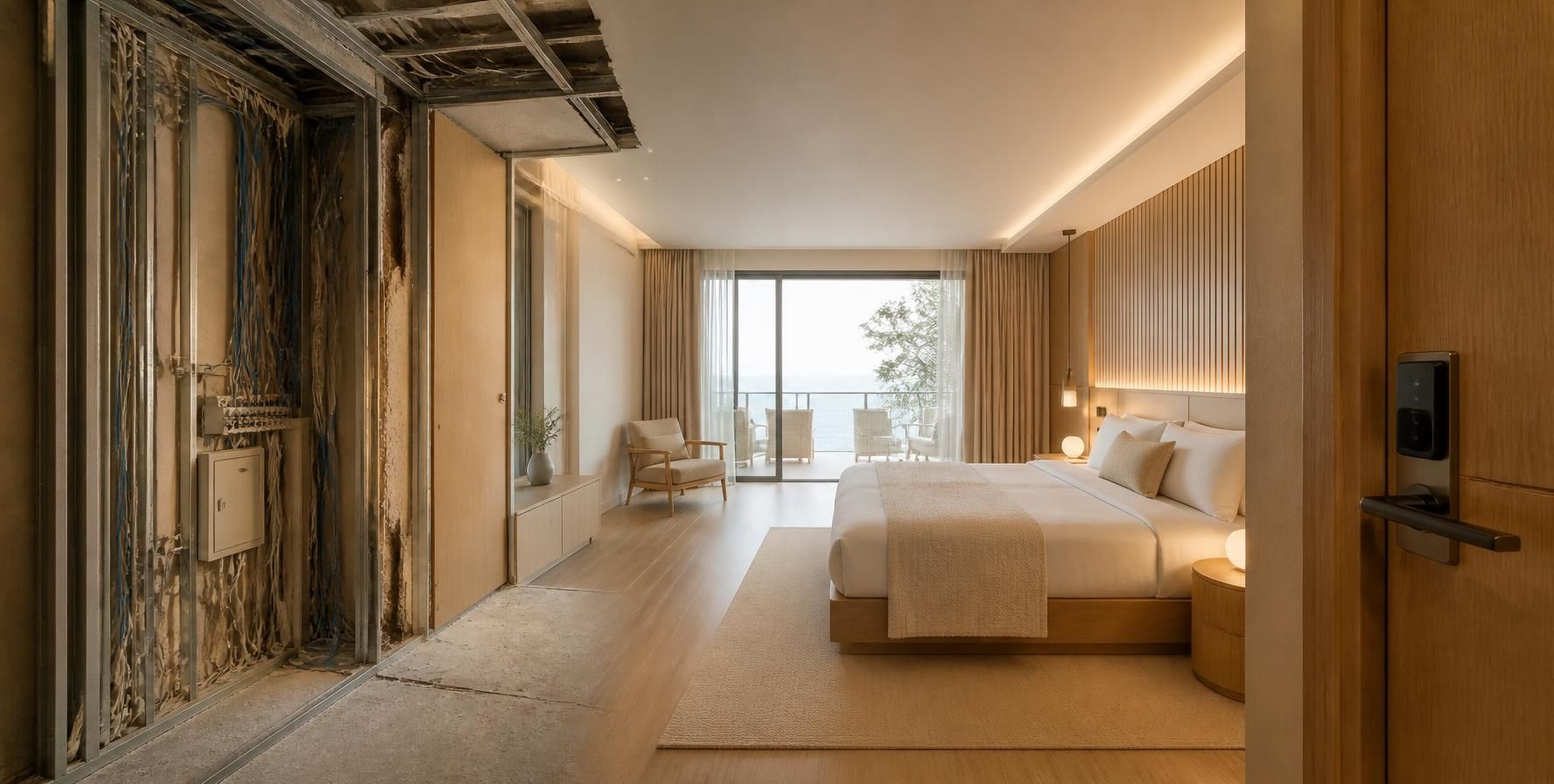
Beyond ITED: the need for an integrated technology project
Digital transformation has profoundly changed the way buildings are designed, constructed and operated. Today, hotels, hospitals, offices and residential developments rely on a seamless and critical technological infrastructure to ensure their day-to-day operations, and this infrastructure goes far beyond the ITED project.
Despite this reality, there remains in Portugal a fundamental confusion between what constitutes an ITED project and what a genuine Telecommunications and Information Systems project should entail.
This overlap frequently leads to incomplete solutions, inadequately specified equipment, changes during construction, budget overruns and operational difficulties that have a direct impact on the management of assets..
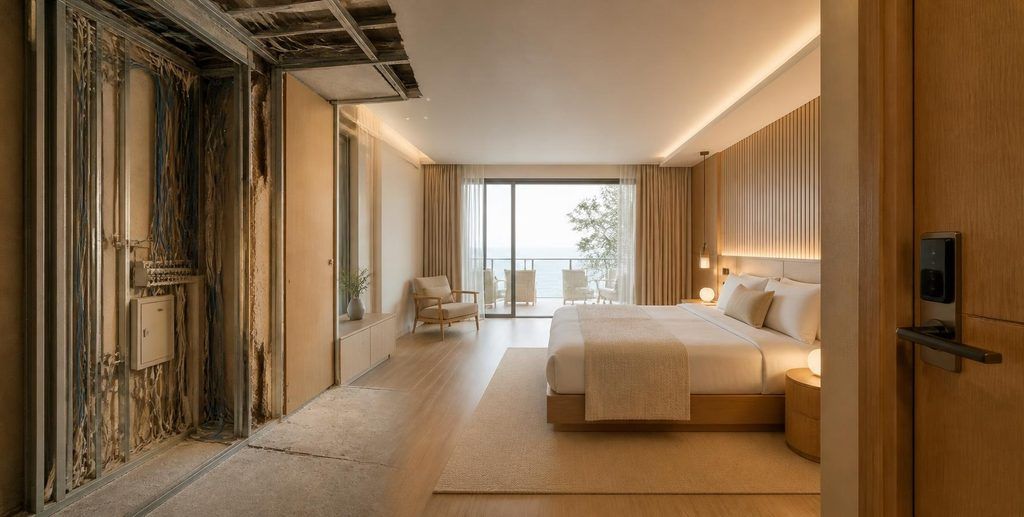
Technology as critical infrastructure
Whilst two decades ago technology was merely ancillary, today it is central. In a hotel, for example, a failure lasting just a few minutes can compromise the PMS, payments, access control, Wi-Fi, IPTV, security and management systems.
Technology has come to be regarded as just as critical as electricity, HVAC or water supply systems. However, it is still often treated merely as the supply of equipment, rather than as a fundamental part of the infrastructure.
Where does the ITED project end?
The ITED Project is essential and fulfils a clear role: to ensure the passive telecommunications infrastructure — ducts, cabling, racks and interconnections.
But its scope ends precisely where the intelligence of the infrastructure begins.
ITED:
-
- Does not define the network architecture
- Does not define cybersecurity
- Does not scale active systems
- Does not establish redundancies
- Does not plan for business continuity
- Does not define the operational technology logic
In other words, it prepares the building for the technology, but does not specify how it should work.
Beyond the ITED project: the real technological project
This is where the Telecommunications and Information Systems Project comes in.
This project is based on ITED, but has a distinct objective: to define the building’s entire technological architecture.
It includes:
-
- LAN and Wi-Fi networks
- IPTV and communications
- Security systems (CCTV, access control)
- Cloud platforms and servers
- Cybersecurity policies
- System integration
- Redundancy and business continuity strategies
Whilst ITED addresses the question of ‘how to build’, this project addresses the question of ‘how to operate’.
Confusing these two aspects inevitably results in technologically fragile buildings.
The need to clarify specialisms
The challenge does not lie in the professionals’ competence, but in clearly defining the boundaries.
Distinguishing between these specialisms makes it possible to:
-
- Higher technical quality
- Lower risk on site
- Reduced operating costs
- Longer system lifespan
- Greater technological security
Modern buildings require an integrated approach, but with clearly defined areas of specialisation.

Rui Picao
IT Strategy | Key Traits: Resilience, Innovation, Availability


Leave a comment